
Home Office Wall Art Ideas: 3 Setups, From Plan to Result
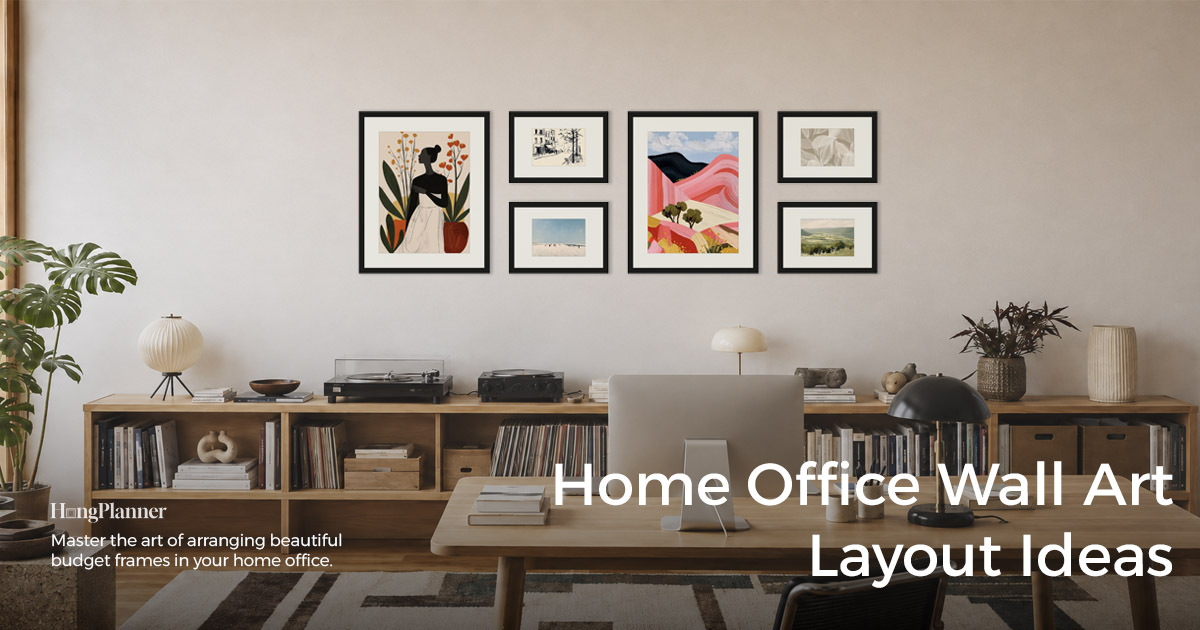
The wall in your home office is one you stare at all day and somehow never get around to. Every idea photo shows a wall packed edge to edge with a full gallery wall, so you assume home office art means rounding up five, six, seven frames too. But a home office is usually smaller than a living or dining room. Cram it full and it just looks busy and loud — and the wall you face all day gets tiring fast.
The short answer: you don’t have to copy a full gallery wall. First figure out which of these your office is closest to — the open wall behind your desk, the squeeze around a monitor, or a small side wall — because how many pieces, which layout, and how high all change with it, and each one has its own worked-out set of IKEA frame sizes. Below, each setup runs room → plan → result. Find yours, then plan it on your own wall in HangPlanner at the end.
Here’s what most “home office art” inspiration never tells you: it hands you a wall of pretty photos but not how to actually hang yours — how many, what size, how high, whether it’ll clash with your monitor. And the home office is the room that should least default to a full wall: it’s small, and it’s the wall you work in front of every day — not one meant to impress guests.
Quick defaults
Scale → an office is small, so start small and add up, don’t default to a full wall: a pair is plenty when a monitor’s in the way, an equal triptych for the open wall behind the desk, a compact cluster for a small side wall.
Which wall → the open wall behind your desk takes an equal triptych; the squeeze around a monitor drops to a pair, off to the side; a small side wall gets a compact cluster.
Frames → for a matched, budget-friendly set use KNOPPÄNG (fibreboard, clean lines); for a mixed-size cluster use RÖDALM (six colours, easy to mix). Keep the art calm and low-contrast (abstracts, line art, black-and-white photography, botanicals) — it suits a room you sit and work in.
Before you start: two quick questions
Before the examples, place yourself with these two — the three setups are just what you get by answering them:
- How much wall? One open wall can carry an equal triptych; a monitor squeeze or a narrow side strip calls for less — a pair or a small cluster. Don’t force it.
- Does it share space with stuff on the desk? A monitor, lamp, or shelf above the desk all fight for that wall, so the art has to yield — step to the side, or drop to a pair. The open wall behind the desk has no such problem and can spread out.
Answer those two and find the setup below that looks most like yours. All three layouts — counts and sizes — are ready-made presets in HangPlanner, so you can copy them straight.
Three common home office setups: room → plan → result
1 · The open wall behind your desk — an equal triptych
The desk sits against the wall, and behind it is one open stretch not chopped up by a cabinet. It’s the most generous surface in the room, and it earns a proper statement.
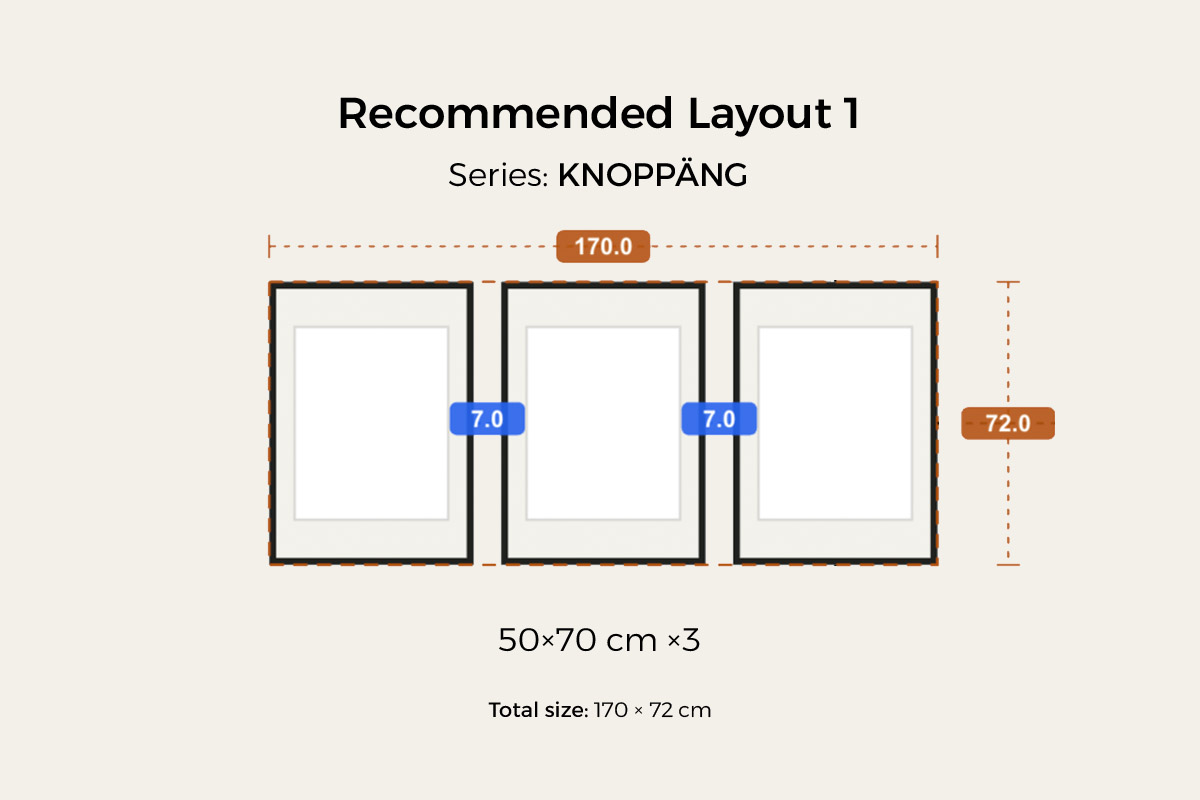
The plan: an equal triptych — three KNOPPÄNG 50×70 cm (≈ 20×28 in) frames side by side, 7 cm gaps, about 170 × 72 cm (≈ 67 × 28 in) overall. Equal sizes at even spacing read as the tidiest, and stay calm even when you face them all day.
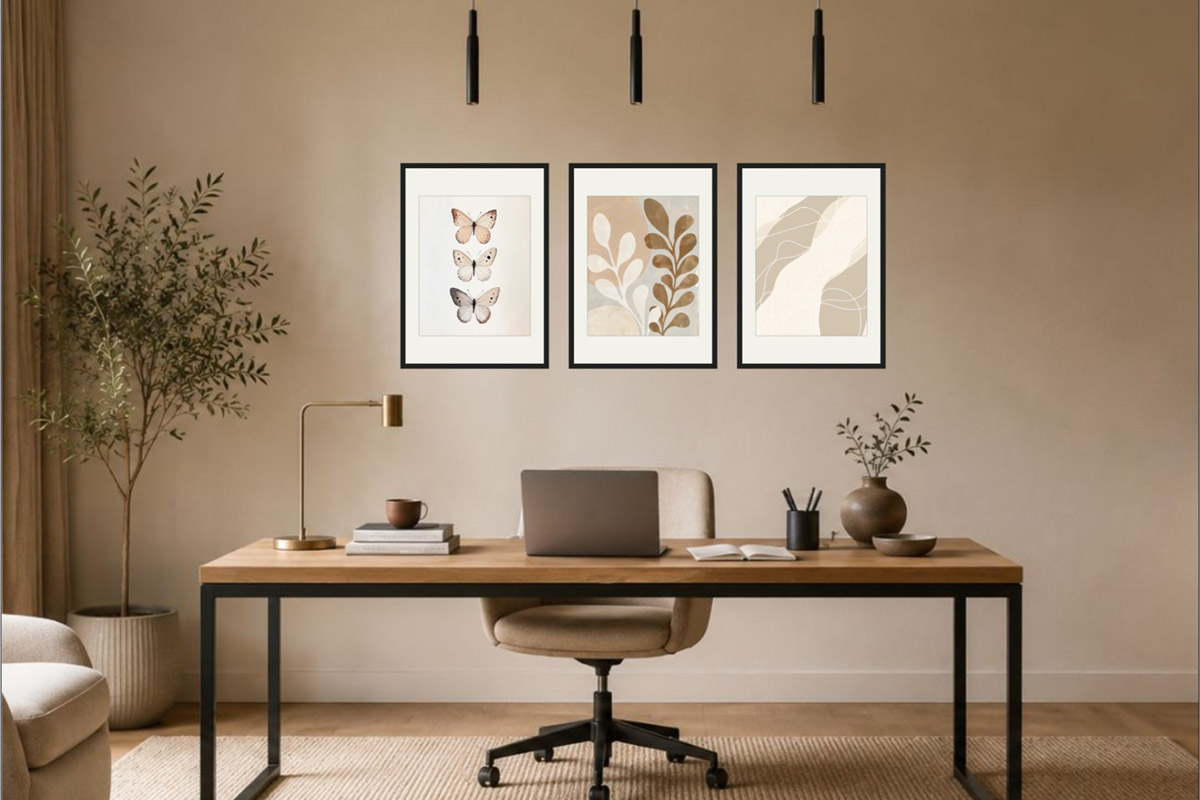
How to hang it: center the group at roughly two-thirds of the desk width, with clearance above the desktop. This wall has the desk as its anchor, so hang it to the desk — not to the standing-eye 57 inches (150 cm) centering rule — the same logic as art above a sofa. Want a different layout? You can also go grid or symmetrical.
2 · Sharing space with a monitor and shelf — just a pair
There’s a monitor on the desk, and maybe a shelf or cabinet overhead. The bit of wall you can actually use is a narrow strip — force a whole group in and it collides with everything.
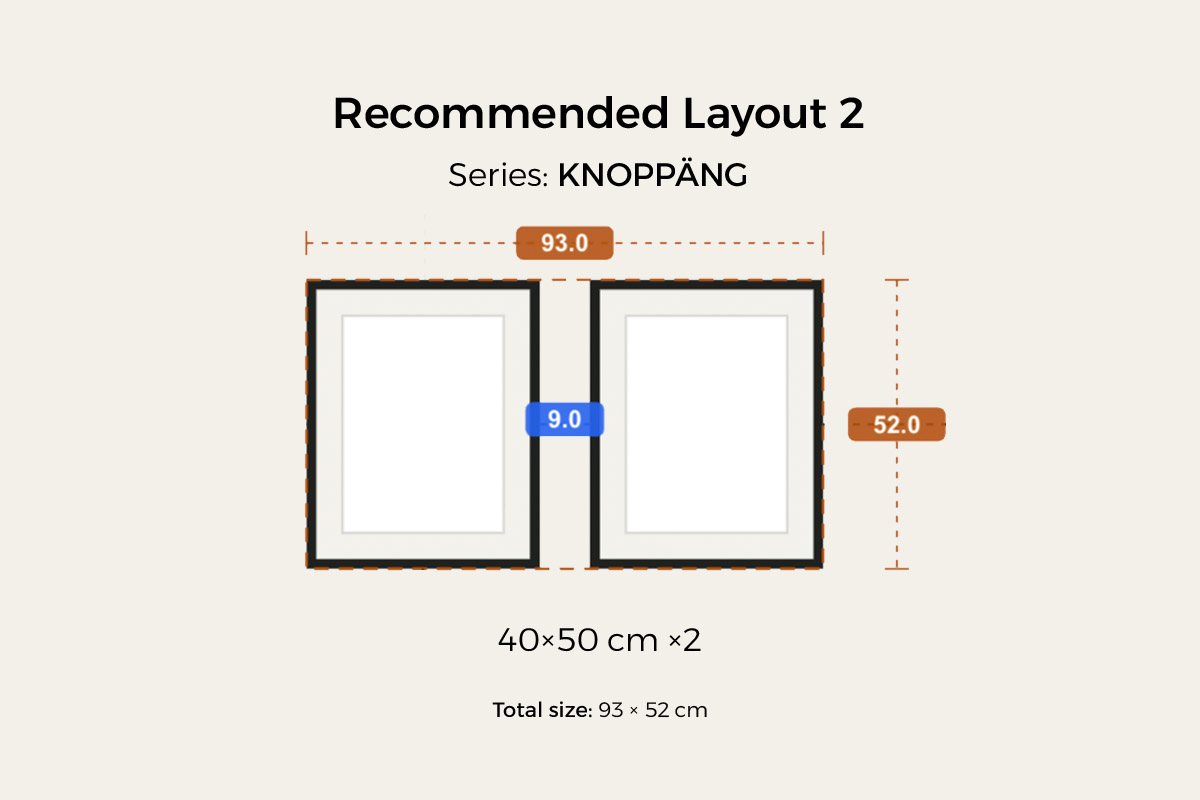
The plan: a pair (diptych) — two KNOPPÄNG 40×50 cm (≈ 16×20 in) frames side by side, 9 cm gap, about 93 × 52 cm (≈ 37 × 20 in) overall. Two equal frames take up little room, tucked into the clear space beside or above the monitor — restrained, without stealing your working sightline.
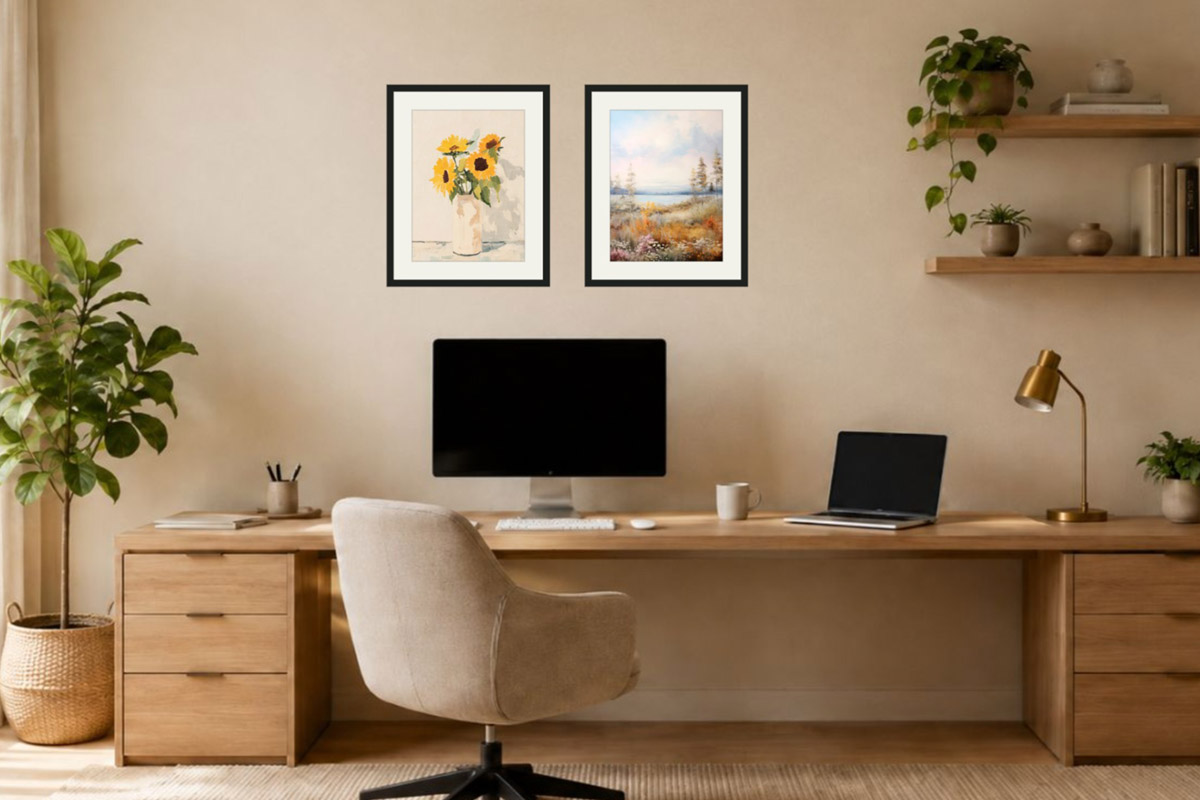
How to hang it: first measure the clear zone — the band of wall between the top of your monitor and the underside of the shelf or cabinet. Keep the pair inside that band, with the bottom edge clear of the line where you look up at the screen and the top edge clear of the shelf. If the zone is tight, slide the pair to the side of the monitor. The same applies to a single piece.
3 · A small side wall — a compact cluster
Beside the desk there’s only a small patch of wall — the bit between the desk and a door or window — with no room for a long row.
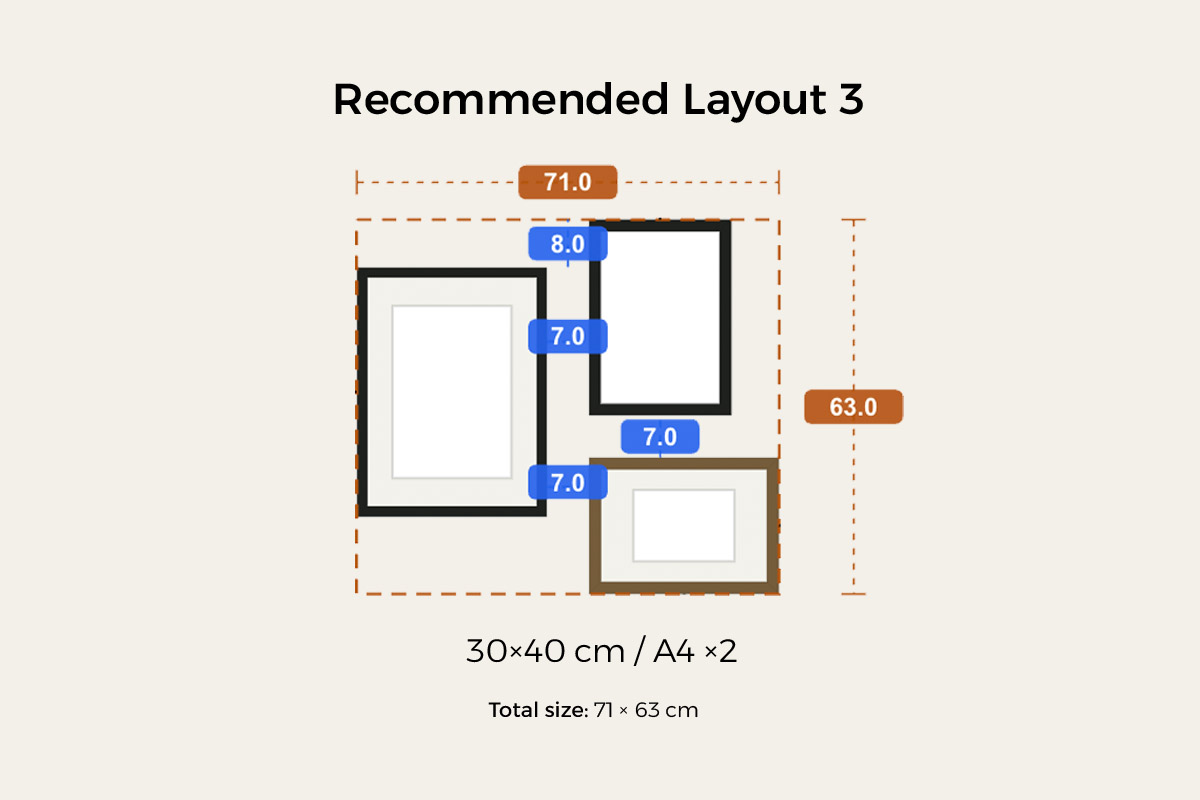
The plan: a compact mixed-size cluster — 30×40 cm (≈ 12×16 in) + A4 (21×29.7 cm) ×2, 7–8 cm gaps, about 71 × 63 cm (≈ 28 × 25 in) overall. Three pieces staggered take up little wall and fit a narrow spot better than forcing a long row.
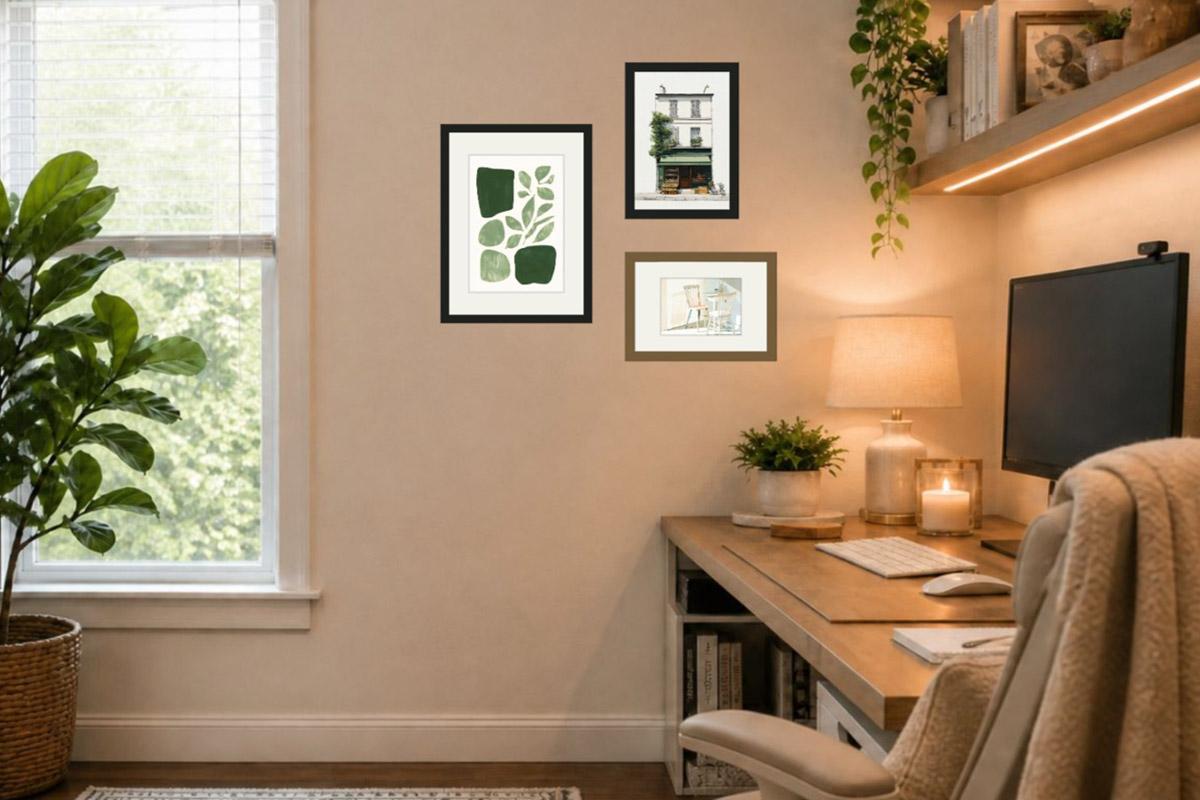
How to hang it: treat the cluster’s outer rectangle as one block, and set its visual center at the height you mostly see it from — sitting, or passing by. If the spot is small, stop at one to three pieces; don’t pad it out. For more structure with mixed sizes, see bottom-aligned or focal.
Plan it on HangPlanner before you buy
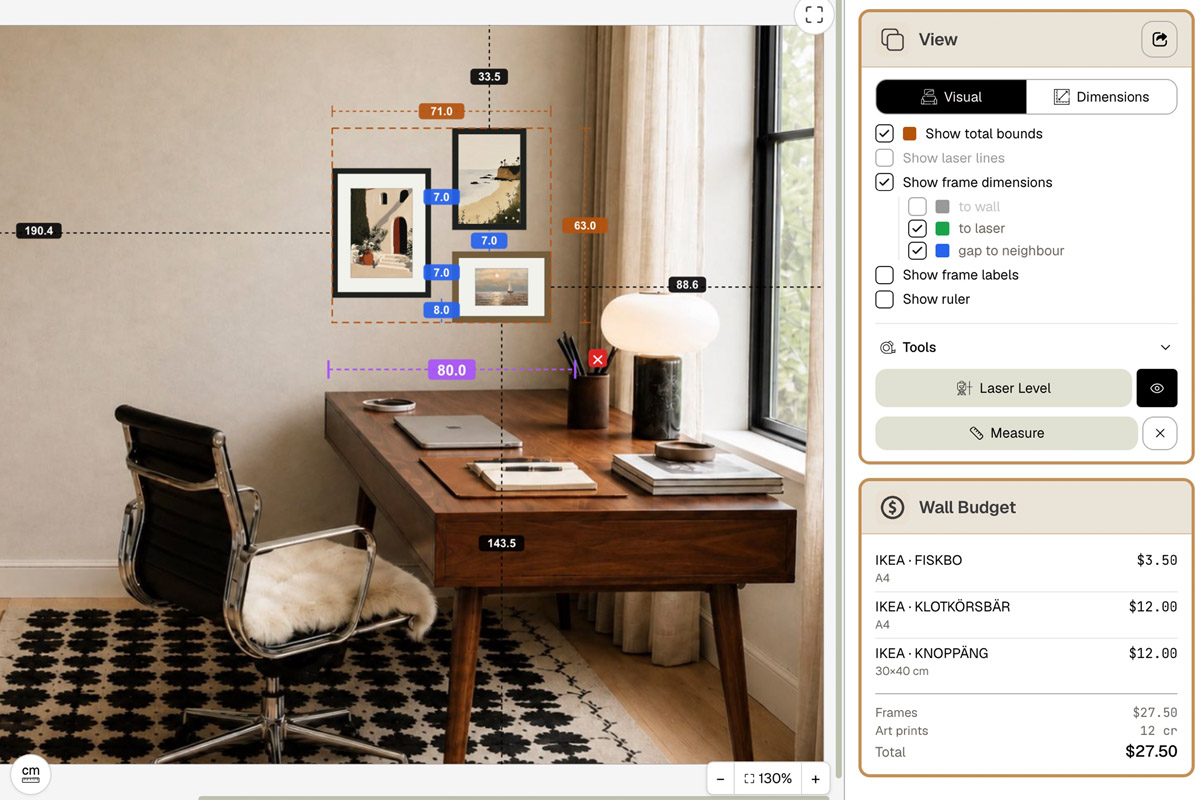
An office is small and unforgiving — the clear band above the desk is tiny, so a drilled hole in the wrong spot or a frame a size too big is more of a pain to fix than in a living room. All three setups can be laid out on screen first:
In HangPlanner:
- Upload a photo of your office and calibrate the scale with a known measurement like the desk width (that’s your own “room” shot)
- Mark where the desk, monitor, lamp, shelf, and doors/windows are, so the art steps around them
- Drop in the preset that matches your setup: a triptych on the open wall behind the desk, a pair for the monitor squeeze, a cluster on a side wall
- Switch to Dimensions and check the overall size, the height above the desk, and each gap against a 2–3 inches (5–7 cm) spacing
- Open Wall Budget to compare per-frame prices and the group total, then decide what to buy
On screen you can see at a glance which version reads clean and which reads cramped — that’s your “after hanging” preview, far cheaper than a wrong hole in the office wall.